
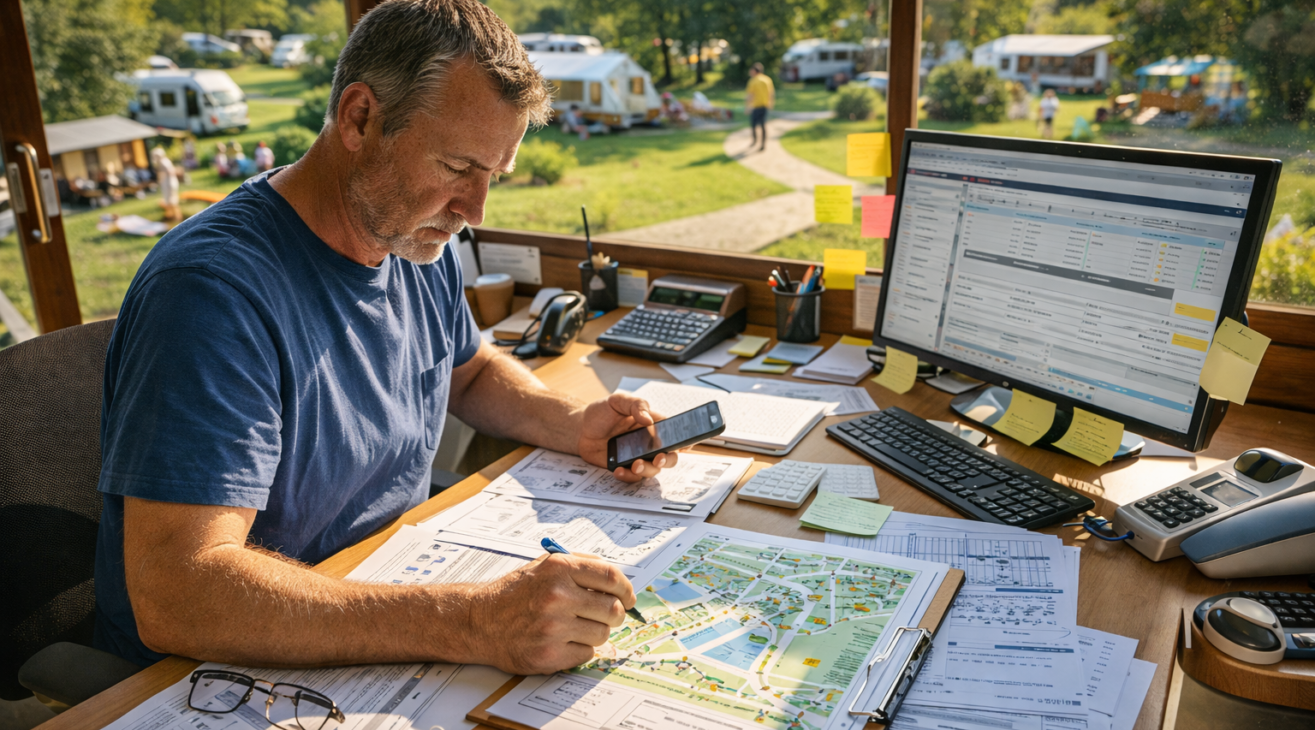
Why Many Campsite Owners Work Too Much
Running a campsite is often seen as a lifestyle business. Many owners enter the industry because they enjoy hospitality, nature and working with guests.
However, once the season starts, reality can look very different.
Many campsite owners find themselves working extremely long hours. Instead of focusing on strategy or improving the campsite, much of their time is spent solving daily operational problems.
Understanding why this happens is the first step toward improving campsite management.
The Hidden Complexity of Campsite Operations
At first glance, a campsite may seem like a relatively simple business. Guests arrive, stay for a few days or weeks, and then leave.
But behind the scenes, campsite management involves many moving parts:
- reservations and booking platforms
- guest communication
- maintenance and technical issues
- cleaning and accommodation preparation
- staff coordination
- administration and accounting
When these systems are not well organized, the owner often becomes the person solving every problem.
Over time, this creates operational pressure.
Owners Often Become the Central Problem Solver
In many campsites, the owner sits at the center of everything.
Staff ask questions. Guests ask questions. Suppliers ask questions. Partners ask questions.
Instead of building systems that allow the business to operate smoothly, many owners unintentionally create a structure where every decision passes through them.
This makes the business dependent on the owner’s constant presence.
While this approach may work in the early years, it becomes difficult to sustain as the campsite grows.
The Difference Between Working In and On the Campsite
Successful campsite businesses often make a clear distinction between two types of work.
Working in the campsite means handling daily operational tasks.
Working on the campsite means improving the business itself.
Examples of working on the campsite include:
- improving the distribution strategy
- selecting better suppliers
- optimizing pricing strategies
- improving the guest experience
- investing in facilities
Owners who spend all their time inside daily operations often have little time left for these strategic improvements.
Systems Reduce Operational Stress
One of the most effective ways to improve campsite management is by introducing clear systems.
These can include:
- reservation software
- channel managers
- outsourced services
- clear staff responsibilities
- structured operational procedures
The goal is not to remove the personal character of the campsite, but to reduce unnecessary complexity.
When systems support daily operations, the owner gains time to focus on growth and long-term planning.
Managing a Campsite Should Be Sustainable
Hospitality businesses require commitment and energy. However, when owners consistently work excessive hours, it often indicates structural inefficiencies.
Sustainable campsite management means creating an operation that functions smoothly even when the owner is not involved in every detail.
In the long term, campsites that invest in clear structures, reliable partners and efficient systems often outperform those that rely entirely on constant personal involvement.
For many owners, improving management is not about working harder — but about working differently.


